La transformación de las pulquerías de la ciudad de México: perspectiva desde sus modelos de negocio
DOI:
https://doi.org/10.22231/asyd.v18i2.862Palabras clave:
Agave; bebidas espirituosas; comercialización de pulque; redes socialesResumen
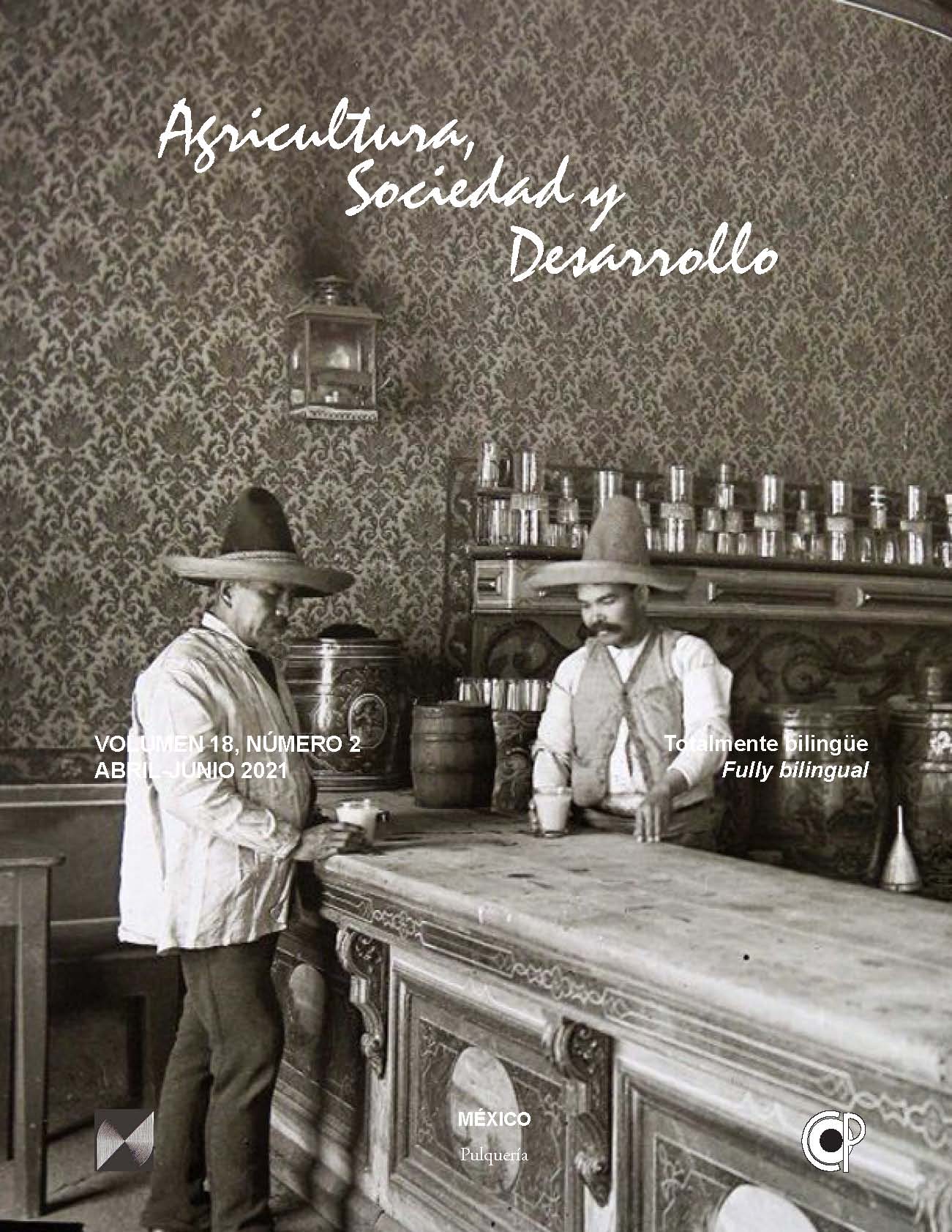
El pulque, principal forma de aprovechamiento de los magueyes pulqueros, ha tomado diversas posiciones en el consumo a lo largo de la historia, y de ser denigrado en el siglo XX actualmente existe un interés creciente por conocer más de esta bebida. El objetivo de esta investigación fue analizar su comercialización en la actualidad, para identificar los factores que la fortalecen, promover su desarrollo e impulsar al resto de la cadena. La investigación se realizó durante los años 2016 y 2017, en 55 negocios expendedores de pulque de la Ciudad de México y área metropolitana. Se llevaron a cabo entrevistas semiestructuradas a los encargados de los negocios, definiendo aspectos de producción y comercialización del pulque, y datos de la vinculación dentro y fuera de este eslabón. Se utilizó el método de análisis de redes sociales, el modelo de negocios y análisis estadísticos para procesar los datos. Se identificaron tres modelos de negocio en función de la estrategia empleada: “tradicional”, “diversificado” y “exitoso”, éste último fue el más redituable en cuanto a litros de pulque vendidos. Existe una tendencia de crecimiento del consumo, lo que impactará positivamente en la estructura de la cadena de valor de maguey-pulque.
Citas
Alexander Osterwalder e Yves Pigneur. (2011). Generacion de Modelos de Negocio, 285. https://doi.org/10.1016/S0737-6782(96)90159-9
Ãlvarez, J. R. (1988). Tomo 11. In Enciclopedia de México. Secretaría de Educación Pública.
Borgatti, S. P., Everett, M. G., & Freeman, L. C. (1992). Ucinet IV Network analysis software. Connections, 15, 12–15.
Chan Kim, W., & Marbougne, R. (2005). La estrategia del Océano Azul. Bogotá, Colombia: Norma.
Díaz Ãlvarez, M. (2009). Las pulquerias de la ciudad de México en el siglo XIX. Bicentenario. El Ayer Y Hoy de México, 2(5), 16–25.
Freeman, L. C. (1979). Centrality in social networks: Conceptual clarification. Social Networks, 1(3), 215–239.
García-Mendoza, A. J. (2007). Los agaves de México. Ciencias, julio-sept(número 087), 14–23. https://doi.org/0187-6376
García Mendoza, A. J. (1998). Con sabor a maguey. México: Universidad Nacional Autónoma de México.
Granados Sánchez, D. (1993). Los Agaves en México. Universidad Autónoma Chapingo.
Markides, C., & Morris, R. (2017). Cómo tomar mejores decisiones estratégicas. Harvard Deusto Business Review, (269), 58–61.
Monterrubio, A. L. (2007). El maguey y el pulque en México. In Las haciendas pulqueras de México (pp. 41–63). México, D.F.: UNAM.
Nalebuff, B. J., & Brandenburger, A. M. (1996). Coo-petencia (Norma Ed.). México.
Peña Timón, V., & Mañas Valle, S. (2015). Narración digital, lectoautor, prosumidor y realidad. Opción, 31(2), 866–876.
Ramírez Aldama, A. F., Velasco Pegueros, A., Onofre González, B. L., Alemán Torres, M. Ã., Rodríguez Tobón, N., Jiménez Báez, P. A., & Ortega Aguilar, U. (2012). Los recuerdos del porvenir: Las pulquerías de la Ciudad de México (Primera ed). México.
Rojas Rivas, E., Viesca González, F. C., Espeitx Bernat, E., & Quintero Salazar, B. (2016). El maguey, el pulque y las pulquerías de Toluca, Estado de México, ¿patrimonio gastronómico turístico? PASOS. Revista de Turismo Y Patrimonio Cultura, 14(5), 1199–1215.
Rovere, M. R. (1999). Redes en salud; un nuevo paradigma para el abordaje de las organizaciones y la comunidad. Secretaría de Salud Pública/AMR.
Wasserman, S., & Faust, K. (1999). Social network analysis in the social and behavioral sciences. Social Network Analysis: Methods and Applications. New York, NY: Cambridge University Press.
Descargas
Publicado
Cómo citar
Número
Sección
Licencia
Los autores/as que publiquen en esta revista aceptan las siguientes condiciones:
- Los autores/as conservan los derechos de autor y ceden a la revista el derecho de la primera publicación, con el trabajo registrado con la licencia de atribución de Creative Commons, que permite a terceros utilizar lo publicado siempre que mencionen la autoría del trabajo y a la primera publicación en esta revista.
- Los autores/as pueden realizar otros acuerdos contractuales independientes y adicionales para la distribución no exclusiva de la versión del artículo publicado en esta revista (p. ej., incluirlo en un repositorio institucional o publicarlo en un libro) siempre que indiquen claramente que el trabajo se publicó por primera vez en esta revista.
- Se permite y recomienda a los autores/as a publicar su trabajo en Internet (por ejemplo en páginas institucionales o personales) antes y durante el proceso de revisión y publicación, ya que puede conducir a intercambios productivos y a una mayor y más rápida difusión del trabajo publicado (vea The Effect of Open Access).