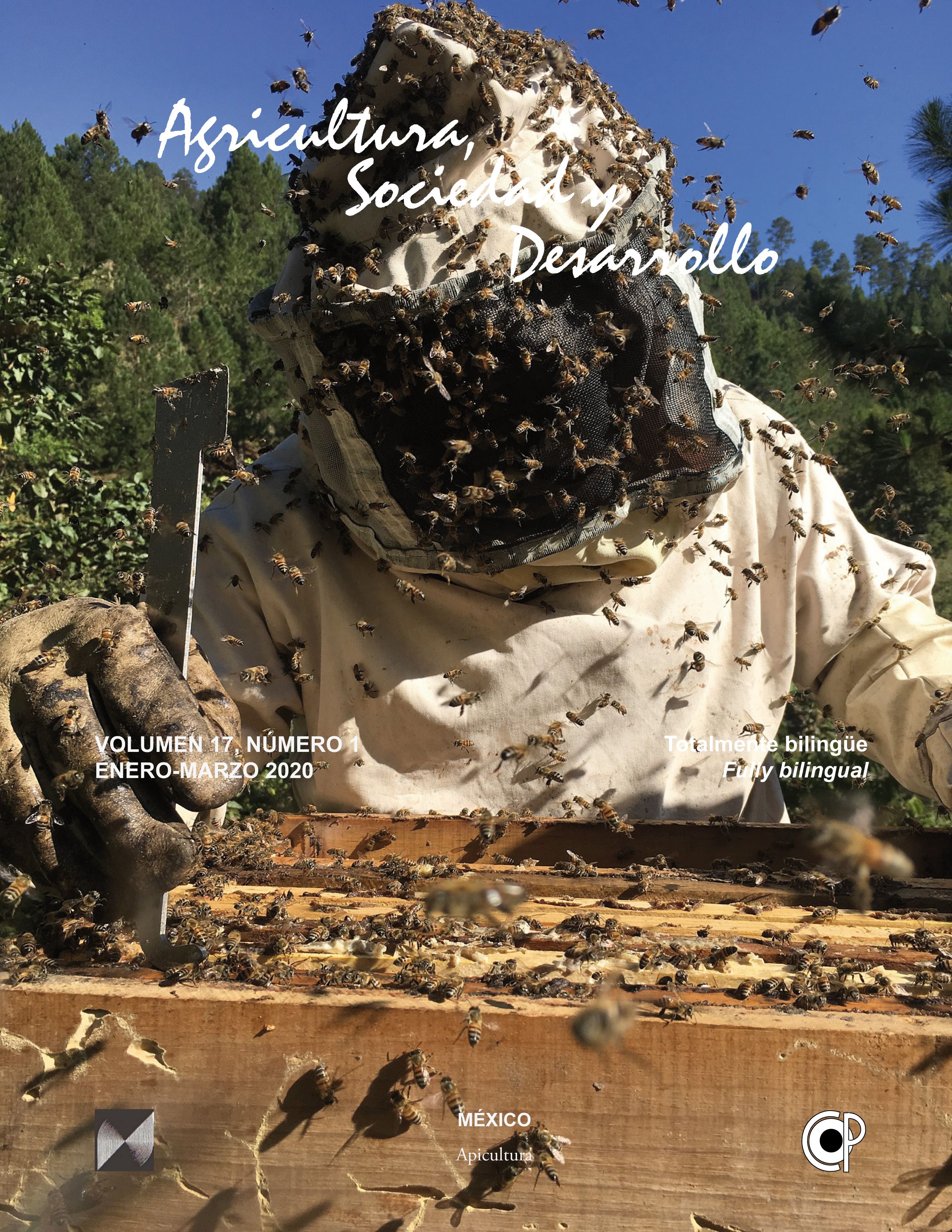
Economic efficiency and organization of the productive chain of honey in Campeche, Mexico
DOI:
https://doi.org/10.22231/asyd.v17i1.1323Keywords:
marketing of honey; cooperatives; competitivenessAbstract
The global food market, based on strict sanitary and quality standards, imposes new challenges to production and marketing by small-scale producers in developing countries. In this article the economic efficiency of small-scale beekeepers is examined, as well as the relationships between actors and the functioning of the honey chain in Campeche, Mexico. The information was obtained through in-depth interviews with key informants, and community workshops. The results show that the conventional honey chain is efficient, although it favors large cooperatives and private trading companies due to economies of scale. Small-scale producers and their organizations can increase their competitiveness through differentiation of the product and diversification of the activity, but only if they are capable of establishing new agreements with other actors of the chain. In addition, the government can favor the development of these organizations and promote commercial, technological and institutional innovations between actors of the chain.
References
Codex Alimentarius Commission Standard for Honey, Codex Stan 12-1981, 2001. http://www.fao.org/input/download/standards/310/cxs_012e.pdf. Consultado marzo 2017.
CONABIO y AECID (Comisión Nacional para el Conocimiento y Uso de la Biodiversidad y Agencia Española de Cooperación Internacional para el Desarrollo). 2011. Plan rector para promover una denominación de origen de mieles de la península de Yucatán. http://www.biodiversidad.gob.mx/usos/mieles/pdf/PlanRector_DenominaOrigenMielesPeninsulaYucatan.pdf. Consultado abril 2016.
Devaux, A., D. Horton, C. Velasco, G. Thiele, G. López, T. Bernet, I. Reinoso, and M. Ordolina. 2009. Collective action for market chain innovation in the Andes. Food Policy. 34: 31-38.
Echazarreta, C. M., E. J. Quezada, L. M. Medina, and K. L. Pasteur. 1997. Beekeeping in the Yucatan Peninsula: development and current status. Bee World. 78(3): 115-127.
Gómez, M. I., C. B. Barrett, L. E. Buck, H. De Groote, S. Ferris, H. O. Gao et al. 2011. Research principles for developing country food value chains. Science. 332(6034): 1154-1155.
Güemes, R. F., G. R. Villanueva, G. C. Echazarreta, A. R. Gómez, and F. J. Pat. 2006. Production costs of conventional and organic honey in the Yucatán Peninsula of Mexico. Journal of Apicultural Research. 45(3): 106-111.
Heyden, Damien, y Patricia Camacho. 2004. Guía metodológica para el análisis de las cadenas productivas. Quito: Plataforma Ruralter. https://www.avsf.org/public/posts/554/gui-a-metodologica-para-el-analisis-de-cadenas-productivas.pdf. Consultado septiembre de 2016.
Hobbs, J., A. Cooney, and M. Fulton. 2000. Value chains in the agrifood-sector: What are they? How do they work? Are they for me? http://usaskstudies.coop/pdf-files/valuechains.pdf. Consultado febrero 2015.
Kruijssen, F., M. Keizer, and A. Giuliani. 2009. Collective action for small-scale producers of agricultural biodiversity products. Food Policy. 34(1): 46-52.
Lee, J., G. Gereffi, and J. Beauvais. 2012. Global value chains and agrifood standards: challenges and possibilities for smallholders in developing countries, Proceedings of the National Academy of Sciences of the United States of America. 109(31): 12326-12331.
Lundy, M., M. Gottret, W. Cifuentes, C. Ostertag, y R. Best. 2004. Diseño de estrategias para aumentar la competitividad de cadenas productivas con productores de pequeña escala. Cali, Colombia: CIAT. https://cgspace.cgiar.org/bitstream/handle/10568/53983/Diseno_estrategias_aumentar_competitividad_cadenas_productivas.pdf. Consultado abril 2017.
Magaña, M. A., O. Y. Moguel, G. Sanginés, y M. Leyva. 2012. Estructura e importancia de la cadena productiva y comercial de la miel en México. Revista Mexicana de Ciencias Pecuarias. 3(1): 49-64.
Markelova, Helen and Ruth Meinzen-Dick. 2009. Collective action for smallholder market access. Capri (6). http://ebrary.ifpri.org/cdm/ref/collection/p15738coll2/id/16414. Consultado mayo 2016.
Markelova, H., R. Meinzen, J. Hellin, and S. Dohrn. 2009. Collective action for smallholder market access. Food Policy. 34(1): 1-7.
Ojeda, Ruth y María Martín. 2008. Factores que explican el funcionamiento de la asociación de apicultores. XII Congreso Internacional de la Academia de Ciencias Administrativas, A. C. Universidad Autónoma de Yucatán. http://acacia.org.mx/busqueda/pdf/M03P13.pdf. Consultado enero 2017.
FAO (Organización de las Naciones Unidas para la Alimentación y la Agricultura). 1997. Agricultural and food marketing management. Marketing and Agribusiness Texts, 2. Roma: FAO.
FAO (Organización de las Naciones Unidas para la Alimentación y la Agricultura). 2007. A Guide to Marketing Costs and How to Calculate Them. Roma: FAO.
FAO (Organización de las Naciones Unidas para la Alimentación y la Agricultura). 2014. Anuario estadístico de la Organización de las Naciones Unidas para la Alimentación y la Agricultura. Santiago. http://faostat.fao.org/site/291/default.aspx. Consultado abril 2015.
Pat, L., G. Calderón, J. Pat, P. Romero, D. Martínez, O., and Cortez. 2014. Profitability and marketing options for small-scale honey producers in Campeche, Mexico. Journal of Animal and Veterinary Advances. 13: 834-842.
Peréz, Paola. 2012. Global standards and local knowledge building: upgrading small producers in the developing countries. Proceedings of the National Academy of Sciences of the United States of America. 109(31): 12344-12349.
Porter, Luciana. 2003. La apicultura y el paisaje maya. Estudio sobre la fenología de floración de las especies melíferas y su relación con el ciclo apícola en la Montaña de Campeche, México. Estudios Mexicanos. 19(2): 303-330.
Raynolds, Laura. 2004. The globalization of organic agro-food networks. World Development. 32(5): 725-743.
Reardon, T., C. Barret, J. Berdegue, and J. F. Swinnen. 2009. Agrifood industry transformation and small farmers in developing countries. World Development. 37(11): 1717-1727.
Ribot, Jesse. 2002. Democratic Decentralization of Natural Resources. Institutionalizing Popular Participation. Washington D. C.: World Resources Institute.
Rosales, Margarita, y Amada Rubio. 2010. Apicultura y organizaciones de apicultores entre los mayas de Yucatán. Estudios de la Cultura Maya. (35): 163-186.
Ruben, R., R. Fort, and G. Zúñiga. 2009. Measuring the impact of fair trade development. Development in Practice. 19(6): 777-788.
SAGARPA (Secretaría de Agricultura, Ganadería, Desarrollo Rural, Pesca y Alimentación). 2009. Manual de buenas prácticas de manufactura, de manejo y envasado de la miel. México: SAGARPA. https://www.gob.mx/cms/uploads/attachment/file/95423/Manejo_y_Envasado_de_la_Miel.pdf. Consultado enero 2017.
SAGARPA (Secretaría de Agricultura, Ganadería, Desarrollo Rural, Pesca y Alimentación). 2013. Decreto por el que se aprueba el programa sectorial de desarrollo agropecuario, pesquero y alimentario 2013-2018. Diario Oficial de la Federación. México: SAGARPA. http://www.dof.gob.mx/nota_detalle.php?codigo=5326584&fecha=13/12/. Consultado febrero 2016.
SAGARPA (Secretaría de Agricultura, Ganadería, Desarrollo Rural, Pesca y Alimentación). 2014. Micrositio Comercio Exterior Agroalimentario. México: SAGARPA. http//www.sagarpa.gob.mx/agronegocios/comercio/Paginas/ComercioExterior.aspx#. Consultado enero 2017
SAGARPA (Secretaría de Agricultura, Ganadería, Desarrollo Rural, Pesca y Alimentación). 2015. Manual de buenas prácticas de producción de miel. México: SAGARPA. https://www.gob.mx/cms/uploads/attachment/file/95427/Producci_n_de_Miel.pdf. Consultado enero 2017.
Saner, G., M. Yercan, S. Engindeniz Karaturhan, and F. Cukur. 2007. Alternative marketing strategies for honey bee and other bee products in Turkey. Journal of Agricultural & Food Information. 8(4): 65-74.
SADC (Southern African Development Community). 2008. Trade Information Brief: Honey. Australian Government-USAID. http://www.sadctrade.org/files/Honey%20Trade%20Information%20Brief.pdf. Consultado marzo 2015.
Van-Beuningen Coen and Peter Knorringa. 2009. Inclusive Improvement: Standards and Smallholders: Taking Stock Moving On. The Netherlands: Hivos / Erasmus University.
Downloads
Published
How to Cite
Issue
Section
License
Copyright (c) 2020 Lucio Alberto Pat Fernández, H. Paulina Romero Durán, Francisco Anguebes-Franceschi, J. Manuel Pat Fernández

This work is licensed under a Creative Commons Attribution-NonCommercial 4.0 International License.
Authors who publish in this journal accept the following conditions:
- The authors retain the copyright and transfer to the magazine the right of the first publication, with the work registered with the Creative Commons attribution license, which allows third parties to use what is published as long as they mention the authorship of the work and the first publication in this magazine.
- Authors may make other independent and additional contractual arrangements for non-exclusive distribution of the version of the article published in this journal (e.g., including it in an institutional repository or publishing it in a book) as long as they clearly indicate that the work It was first published in this magazine.
- Authors are permitted and encouraged to publish their work on the Internet (for example on institutional or personal pages) before and during the review and publication process, as it can lead to productive exchanges and greater and faster dissemination of the work. published (see The Effect of Open Access).