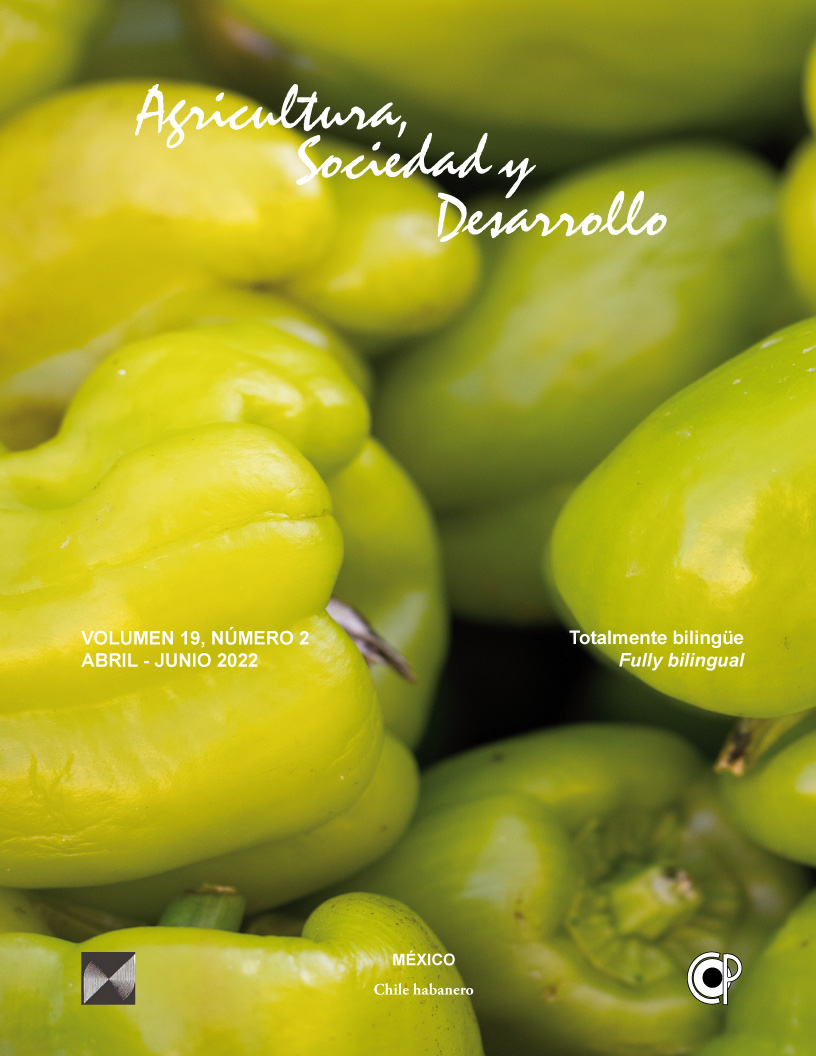
Quality of habanero chili peppers in the markets of Mexico: a comparative analysis
DOI:
https://doi.org/10.22231/asyd.v19i2.1383Keywords:
Fuzzy logic, quality characteristics, habanero chili pepper, competitivenses, exportAbstract
The high competitiveness of markets derives from the introduction of technology and the dynamics of consumer needs. It is necessary to improve the quality of products and, especially, in the agricultural sector. The objective of this research was to compare the characteristics of habanero chili peppers (Capsicum chinense) for export with those for sale in Mexico City markets through fuzzy logic, in order to determine their quality. Fuzzy logic is a qualitative method used to study social phenomena surrounded by uncertainty and subjectivity. Based on the standard “Denomination of Origin of habanero pepper from the Yucatan Peninsula”, the results show that the quality in shape and color of the habanero peppers sold in Mexico City is lower than that of those exported. Information on the quality of chili peppers distributed within the country and for export helps farmers and the government to generate specific policies and regulatory programs of differentiated support, according to the types of crops and the place where they are produced.
References
Amaro-Rosales M, De Gortari-Rabiela R. 2016. Políticas de transferencia tecnológica e innovación en el sector agrícola mexicano. Agricultura, Sociedad y Sesarrollo, 13(3).
Arana-Coronado J, Trejo-Pech C, Aguilar-Candelas O, Martínez-Damián M, Mondragón-Hernández R. 2019. Crecimiento potencial de las exportaciones de fresa (Fragaria) mexicana. Agrociencia, 53: 417-431.
Arellano-Díaz H. 2017. La calidad en el servicio como ventaja competitive. Dominio de las Ciencias, 3(Mon): 72-83.
Artopoulos A, Friel D, Hallak JC. 2014. Levantando el velo doméstico: el desafío de exportar bienes diferenciados a países desarrollados. Desarrollo Económico, 53: 285-311.
Basurto Hernández S, Escalante Semerena R. 2012. Impacto de la crisis en el sector agropecuario en México. Economía UNAM, 9(25).
Blanco Cruz LJ, Libreros A, Moscoso F. 2015. Desafíos de la globalización, mercados, normas y empresas, Bogotá, Escuela de Administración de Negocios. DOI: 10.13140/RG.2.1.4427.6969
Brambilla I, Lederman D, Porto G. 2012. Exports, export destinations and skills. American Economic Review, 102(7): 3406-38. DOI: 10.1257/aer.102.7.3406
Corrales-Garcia J, Alonso Carrillo MG, Santos GA, Sandoval AG, Hernández Trejo MM, Justo Gómez MDR, Lara Ruiz G, López M. 2002. El sistema agroindustrial chile habanero en Yucatán. In: Gómez Cruz, M.
A., Schwentesius Rindermann, R y Covarrubias Gutiérrez, I (coord). Frutas y Hortalizas, Estado Actual y Nuevas Alternativas en México. 81-96. México. PIAI-CIESTAAM. Universidad Autónoma Chapingo y RISHORT.
Corrales-García J, Carrillo MA, Santos GA, Sandoval AG, Trejo MM, Justo Gómez MDR, Lara Ruiz G, López NM. 2014. El sistema agroindustrial chile habanero en Yucatán, Frutas y hortalizas: estado actual y nuevas alternativas en México. In: Frutas y Hortalizas, Estado Actual y Nuevas Alternativas en México. 81-96. México. PIAI-CIESTAAM. Universidad Autónoma Chapingo y RISHORT.
Coppelli Ortiz G. 2018. La globalización económica del siglo XXI. Entre la mundialización y la desglobalización. Estudios Internacionales, 50(191). http://dx.doi.org/10.5354/0719-3769.2019.52048
Cruz-Delgado D, Leos-Rodríguez JA, Altamirano-Cárdenas R. 2013. México: factores explicativos de la producción de frutas y hortalizas ante la apertura comercial. Revista Chapingo. Serie Horticultura, 19(3):267-278. http://dx.doi.org/10-5154/r.rchsh.2012.05.029.
Dávila Newman G. 2006. El razonamiento inductivo y deductivo dentro del proceso investigativo en ciencias experimentales y sociales. Laurus, 12(Ext): 180-205.
Estrella Ramón AM, Jiménez Castillo D, Ruiz Real JL, Sánchez Pérez M. 2012. ¿Cómo compiten las pymes en los mercados internacionales? análisis de un clúster local con vocación exportadora. Investigaciones Europeas de Dirección y Economía de la Empresa, 18(1): 87-99.
Fideicomiso de Riesgo Compartido. 2017. Chile Habanero, con Denominación de Origen, Gobierno de México. Recuperado de https://www.gob.mx/firco/articulos/chile-habanero-con-denominacion-deorigen?idiom=es
Fundación Produce Sinaloa A. C. 2011. El chile habanero: una excelente oportunidad para los productores. Recuperado de https://www.fps.org.mx/portal/index.php/notas/1002-el-chile-habanero-una-excelenteoportunidad-para-los-productores
Giménez RC, Martínez SY, Calzada BV, Sainz MT, Luaces CC. 2014. Evaluación de los indicadores de calidad en intoxicaciones pediátricas en un servicio de urgencias. Anales de Pediatría, 80(1):34-40. https://doi.org/10.1016/j.anpedi.2013.05.004
González Cantó JS, Poblador E, Ortuño Alonso M. 2017. Evaluación de los indicadores de la calidad analítica en un laboratorio clínico. Revista del Laboratorio Clínico, 10(4): 180-188. https://doi.org/10.1016/j.labcli.2017.07.002.
IMPI (Instituto Mexicano de la Propiedad Industrial). 2014. Declaratoria General de Protección de la Denominación de Origen Chile Habanero de la Península de Yucatán: Diario Oficial, México. Lee SS. 2014. Using fuzzy-set qualitative comparative analysis. Epidemiology and health, 36, e2014038. https://doi.org/10.4178/epih/e2014038
Maldonado-Siman E, Bernal-Alcántara R, Cadena-Meneses J, Altamirano-Cárdenas R, Martínez-Hernández P. 2014. Implementation of quality systems by Mexican exporters of processed meat. Journal of Food Protection, 77(12): 2148-2152. https://doi.org/10.4315/0362-028X.JFP-14-003
Metzger O, Spengler T. 2019. Modeling rational decisions in ambiguous situations: a multi-valued logic approach. Bus Res, 12: 271–290. https://doi.org/10.1007/s40685-019-0087-5
Ministry of of Agriculture and Rural Development (Mexico). November 19, 2021. Leading agri-food products exported from Mexico in 2020, by value (in million U.S. dollars) [Graph]. In Statista. Retrieved August 02, 2022. Recuperado de https://s443-www-statista-com.lasalle.lsproxy.net/statistics/911452/mexico-leading-agricultural-products-exports-value/
Pacheco-López N, Patrón-Vázquez J, Ramos-Diaz A, Talavera-Ayora T. 2017. Inocuidad de Chile Habanero en la Producción Primaria. Centro de Investigación y Asistencia en Tecnología y Diseño del Estado de Jalisco A. C.(CIATEJ).
Saad R, Ahmad MZ, Abu MS, Jusoh MS. 2014. Hamming distance method with subjective and objective weights for personnel selection. Scientific World Journal, 1( 9). https://doi.org/10.1155/2014/865495
SAGARPA (Secretaría de Agricultura y Desarrollo Rural). 2015. México, líder mundial en exportación de chile: SAGARPA. (721/15). México: Ciudad de México.
SAGARPA. 2017a. Chillies and peppers export value in Mexico between 2016 and 2030 (in million U.S. dollars).
SAGARPA. 2017b. Planeación agrícola nacional 2017-2030. Chiles y Pimientos mexicanos. 5. Disponible en: https://www.gob.mx/cms/uploads/attachment/file/257072/Potencial-Chiles_y_Pimientos-parte_uno.pdf
Sugeno M, Yasukawa T. 1993. A fuzzy-logic-based approach to qualitative modeling, IEEE Transactions on Fuzzy Systems, 1( 1): 7 DOI: 10.1109/TFUZZ.1993.390281.
Torres Fragoso J, Luna Espinoza I. 2017. Evaluación de la percepción de la calidad de los servicios bancarios mediante el modelo SERVPERF. Contaduría y Administración, 62(4): 1270–1293. http://dx.doi.org/10.1016/j.cya.2016.01.009.
Valencia Sandoval K, Duana Avila D, Hernández Gracia TJ. 2017. Estudio del mercado de papaya mexicana: un análisis de su competitividad (2001-2015). Suma de Negocios, 8: 131-139. https://doi.org/10.1016/j.sumneg.2017.10.002
Zadeh L. 1965. Fuzzy sets. Information and Control, 8:338-353. https://doi.org/10.1016/S0019-9958(65)90241-X.
Zamora Torres IA, Pedraza Rendón O. 2013. El transporte internacional como factor de competitividad en el comercio exterior. Journal of Economics, Finance and Administrative Science, 18(35):108-118.
Published
How to Cite
Issue
Section
License
Copyright (c) 2022 Carmen Lozano, Cesaire Chiatchoua

This work is licensed under a Creative Commons Attribution-NonCommercial 4.0 International License.
Authors who publish in this journal accept the following conditions:
- The authors retain the copyright and transfer to the magazine the right of the first publication, with the work registered with the Creative Commons attribution license, which allows third parties to use what is published as long as they mention the authorship of the work and the first publication in this magazine.
- Authors may make other independent and additional contractual arrangements for non-exclusive distribution of the version of the article published in this journal (e.g., including it in an institutional repository or publishing it in a book) as long as they clearly indicate that the work It was first published in this magazine.
- Authors are permitted and encouraged to publish their work on the Internet (for example on institutional or personal pages) before and during the review and publication process, as it can lead to productive exchanges and greater and faster dissemination of the work. published (see The Effect of Open Access).